Chapter 14 Current Electricity Physics 10th Class Kpk MCQ Tests
10th Class Physics Chapter 14 MCQ Tests
Chapter 14 of 10th Class Physics has 36 questions. If you take an online MCQ test, the system will randomly choose the questions. If you want to take the quiz by chapter then click the start test button.
Total Questions: 36
Total Marks: 36
Time: 40 Mins
Total Questions: 36
Total Marks: 36
Time: 40 Mins
40Min : 00 Sec Remaining
Question # 1
Increase in which of the following factors causes an increase in the resistance of a wire?
Question # 2
How long a current of 10 mA takes to deliver 30 C of charge?
Question # 3
Each home appliance is connected to main supply through a fuse and a switch. Which of the wires of electric supply is connected through fuse and switch?
Question # 4
Why is AC transfer more effective than DC transfer over long distances?
Question # 5
Why a thin region of light bulb filament has more possibility to burn than the thicker one?
Question # 6
The ohm's law applies under which of the following conditions?
Question # 7
If a 900 V source is connected in a series circuit, voltage is divided across three series resistors of V1 = 300 V, V2 = 280V and V3. What is the value of V3?
Question # 8
Which of the following is a characteristic of a fuse wire?
Question # 9
The flow of which of the following causes an electric current in conductors?
Question # 10
Why should household appliances be connected in parallel to the voltage source?
Question # 11
Why is electric energy measured in kilowatt hour?
Question # 12
If 0.5 C charge passes through a wire in a time of 10 s, then what will be the value of current flowing through the wire?
Question # 13
Where is the fuse connected in the circuit?
Question # 14
An electric motor is running with 220 V and 1.5 A current. What is the energy supplied by it in kilowatt-hour in 5 hours?
Question # 15
Which of the following represents unidirectional current?
Question # 16
Which of the following statements is true about a discharge tube?
Question # 17
If a live wire comes in contact with metal casing, excess current moves to which of the following?
Question # 18
Why is electric potential of Earth taken as zero?
Question # 19
If the length of copper wire is 1 m and its diameter is 2 mm, then what is the resistance of this copper wire?

Question # 20
A wire has a resistance of 8 Ω. A second wire, made of the same material, has half the length and twice the cross-sectional area, as compared to that of the first wire. What is the resistance of the second wire?
Question # 21
An electric bulb is marked with 220 V, 100 W. What is the energy in kilowatt-hour consumed by the bulb in one month, if it has been used for 5 hours daily?
Question # 22
Why power companies supply AC, not DC?
Question # 23
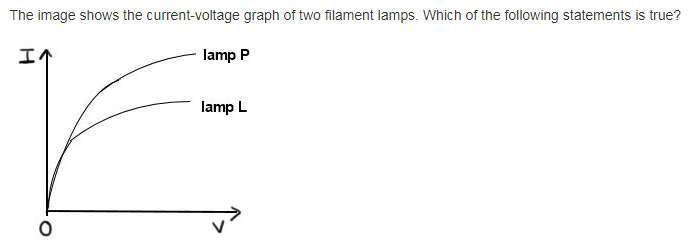
The image shows the current-voltage graph of two filament lamps. Which of the following statements is true?
Question # 24
What type of electrical component is a circuit breaker?
Question # 25
Why are automobile headlights connected in parallel?
Question # 26
An incandescent light bulb with an operating resistance of 95 Ω is labelled "150 W". Is this bulb designed to be used in a 120 V circuit or 220 V circuit?
Question # 27
Which of the following currents passes from a point at higher potential to a lower potential?
Question # 28
The resistance of conductor wire is 10 MΩ. If a potential difference 100 volt is applied across its ends, then what will be the value of current passing through it in mA?
Question # 29
The current in an electric heater is 12 A. It is switched on for seven minutes. How much charge flows through the heater?
Question # 30
What is the resistance of the filament of a bulb, if the bulb is marked with 220 V, 100 W?
Question # 31
Two resistances of 6 kΩ and 12 kΩ are connected in parallel. A 6 V battery is connected across the ends of this circuit. What is the equivalent resistance and potential difference across each resistance?
Question # 32
Why the filament bulb doesn't obey Ohm's law?
Question # 33
Why bends in a wire do not effect its electrical resistance?
Question # 34
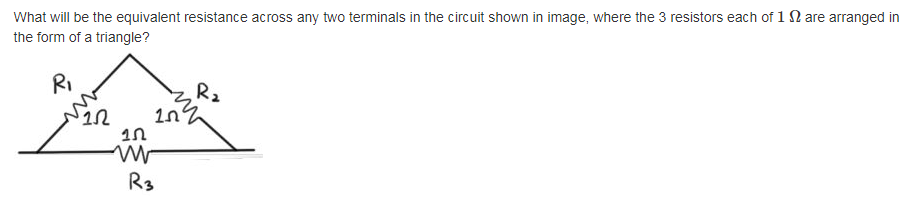
What will be the equivalent resistance across any two terminals in the circuit shown in image, where the 3 resistors each of 1 Ω are arranged in the form of a triangle?
Question # 35
The resistance of a conductor wire is 10 MΩ. If a potential difference of 100 volt is applied across its ends, then what will be the value of current passing through it in mA?
Question # 36
Circuit breaker works on which of the following principles?
Total Questions
123456789101112131415161718192021222324252627282930313233343536
Question # 1
Increase in which of the following factors causes an increase in the resistance of a wire?
Question # 2
How long a current of 10 mA takes to deliver 30 C of charge?
Question # 3
Each home appliance is connected to main supply through a fuse and a switch. Which of the wires of electric supply is connected through fuse and switch?
Question # 4
Why is AC transfer more effective than DC transfer over long distances?
Question # 5
Why a thin region of light bulb filament has more possibility to burn than the thicker one?
Question # 6
The ohm's law applies under which of the following conditions?
Question # 7
If a 900 V source is connected in a series circuit, voltage is divided across three series resistors of V1 = 300 V, V2 = 280V and V3. What is the value of V3?
Question # 8
Which of the following is a characteristic of a fuse wire?
Question # 9
The flow of which of the following causes an electric current in conductors?
Question # 10
Why should household appliances be connected in parallel to the voltage source?
Question # 11
Why is electric energy measured in kilowatt hour?
Question # 12
If 0.5 C charge passes through a wire in a time of 10 s, then what will be the value of current flowing through the wire?
Question # 13
Where is the fuse connected in the circuit?
Question # 14
An electric motor is running with 220 V and 1.5 A current. What is the energy supplied by it in kilowatt-hour in 5 hours?
Question # 15
Which of the following represents unidirectional current?
Question # 16
Which of the following statements is true about a discharge tube?
Question # 17
If a live wire comes in contact with metal casing, excess current moves to which of the following?
Question # 18
Why is electric potential of Earth taken as zero?
Question # 19
If the length of copper wire is 1 m and its diameter is 2 mm, then what is the resistance of this copper wire?
Question # 20
A wire has a resistance of 8 Ω. A second wire, made of the same material, has half the length and twice the cross-sectional area, as compared to that of the first wire. What is the resistance of the second wire?
Question # 21
An electric bulb is marked with 220 V, 100 W. What is the energy in kilowatt-hour consumed by the bulb in one month, if it has been used for 5 hours daily?
Question # 22
Why power companies supply AC, not DC?
Question # 23
The image shows the current-voltage graph of two filament lamps. Which of the following statements is true?
Question # 24
What type of electrical component is a circuit breaker?
Question # 25
Why are automobile headlights connected in parallel?
Question # 26
An incandescent light bulb with an operating resistance of 95 Ω is labelled "150 W". Is this bulb designed to be used in a 120 V circuit or 220 V circuit?
Question # 27
Which of the following currents passes from a point at higher potential to a lower potential?
Question # 28
The resistance of conductor wire is 10 MΩ. If a potential difference 100 volt is applied across its ends, then what will be the value of current passing through it in mA?
Question # 29
The current in an electric heater is 12 A. It is switched on for seven minutes. How much charge flows through the heater?
Question # 30
What is the resistance of the filament of a bulb, if the bulb is marked with 220 V, 100 W?
Question # 31
Two resistances of 6 kΩ and 12 kΩ are connected in parallel. A 6 V battery is connected across the ends of this circuit. What is the equivalent resistance and potential difference across each resistance?
Question # 32
Why the filament bulb doesn't obey Ohm's law?
Question # 33
Why bends in a wire do not effect its electrical resistance?
Question # 34
What will be the equivalent resistance across any two terminals in the circuit shown in image, where the 3 resistors each of 1 Ω are arranged in the form of a triangle?
Question # 35
The resistance of a conductor wire is 10 MΩ. If a potential difference of 100 volt is applied across its ends, then what will be the value of current passing through it in mA?
Question # 36
Circuit breaker works on which of the following principles?
Total Questions
123456789101112131415161718192021222324252627282930313233343536
Physics MCQ Test by Topics
- +14.1 Electric Current
- +14.2 Potential Difference and emf
- +14.3 Ohm's Law
- +14.4 Electrical Resistance (R)
- +14.5 Combinations of Resistances
- +14.6 The I-V Characteristics for OHMIC and Non OHMIC Conductors
- +14.7 Electrical Power and joule's Law
- +14.8 Uses of Circuit Components
- +14.9 Electrical Measuring Instruments
- +14.10 Direct and Alternating Current
- +14.11 House Circuits
- +14.12 Dangers of Electricity
Physics
10th Class Kpk MCQ Tests







10th Class Online Classes 2026
Updated on: 17-10-2026
10th Class Online Preparation
10th Class 2026 Online
10th Class 2026
Add a Comment
Comments will be shown after admin approval.
Spam comments will not be approved at all.
Matric Result 2026 Punjab
10th Class Result 2026 Punjab
9th Class Result 2026 Punjab Boards
10th Class Result Gazette 2026 Punjab
Punjab Past Papers Matric 9th 10th
Primary Results 5th & 8th Class
BISE Results Intermediate & Matric
BISE Punjab Boards
Sindh Educational Boards
KPK Examination Boards
Technical Boards
Public Service Commission
University Results Gruaduation, Masters Classes
Subscribe by Email
Subscribe by Email
Subscribe to Rss Feed


Position Holders Matric 2026
Position Holders 9th Class 2026
Position Holders Inter 2026
Position Holders 11th Class 2026
Kpk 10th Class Physics